
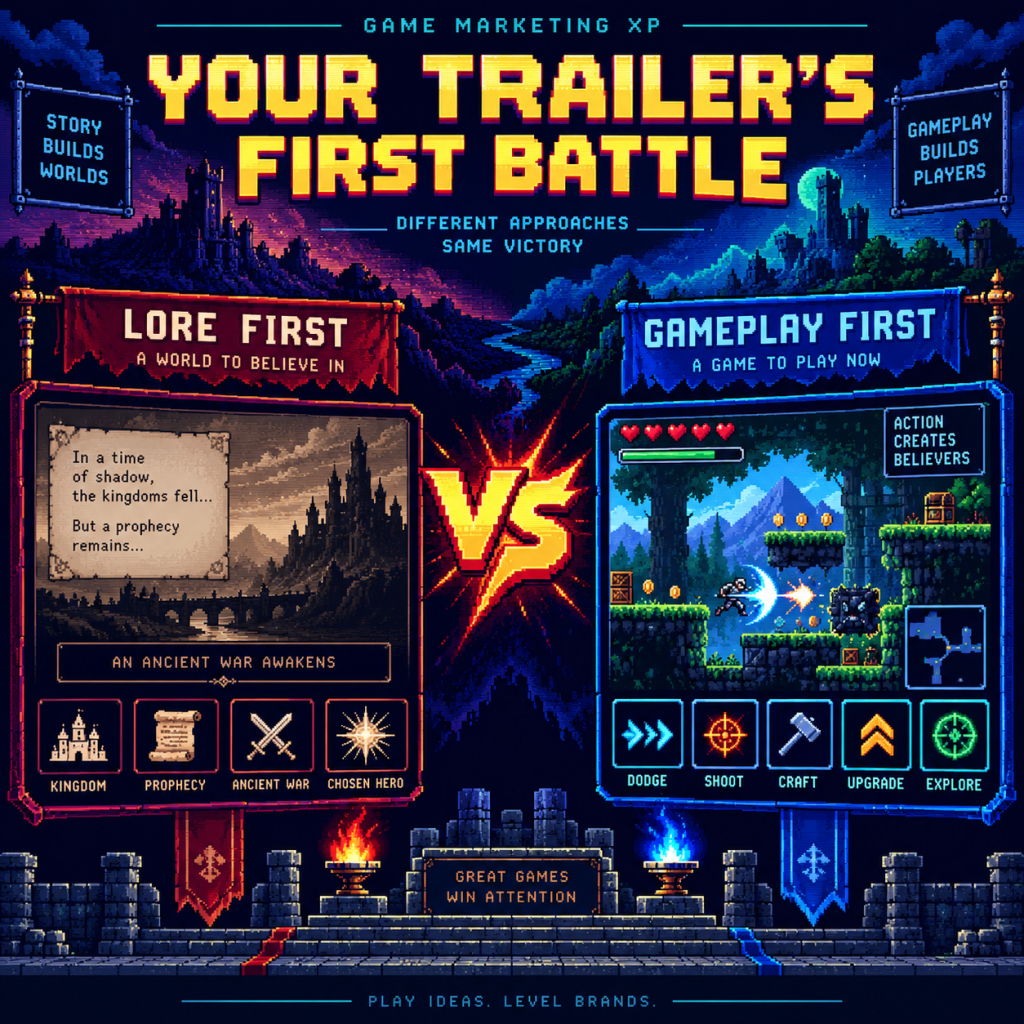
A very common mistake a lot of developers make, especially indies, is focusing too much on order and on the historical context of the game. They start with the setup, with everything related to the contextual part of the story, when in reality they should think like anyone editing a video: knowing you have a very short attention window, in the first 3 to 5 seconds.
Chris Zukowski, a game marketing consultant and strategist behind How To Market A Game (his Steam data analysis is regularly cited by outlets like Game Developer, and he gives GDC talks on the topic), reaches basically the same conclusion from the data side: analyzing how Steam buyers navigate trailers, he found that people scroll until they find real gameplay, and on social media the margin is even shorter. His recommendation is to cut to actual gameplay within the first two seconds, no studio logo floating at the start, no text cards like “In a world of magic and chaos…” (source: 60 Game Marketing Mistakes, howtomarketagame.com).
Nobody Cares About Your Lore (Yet)
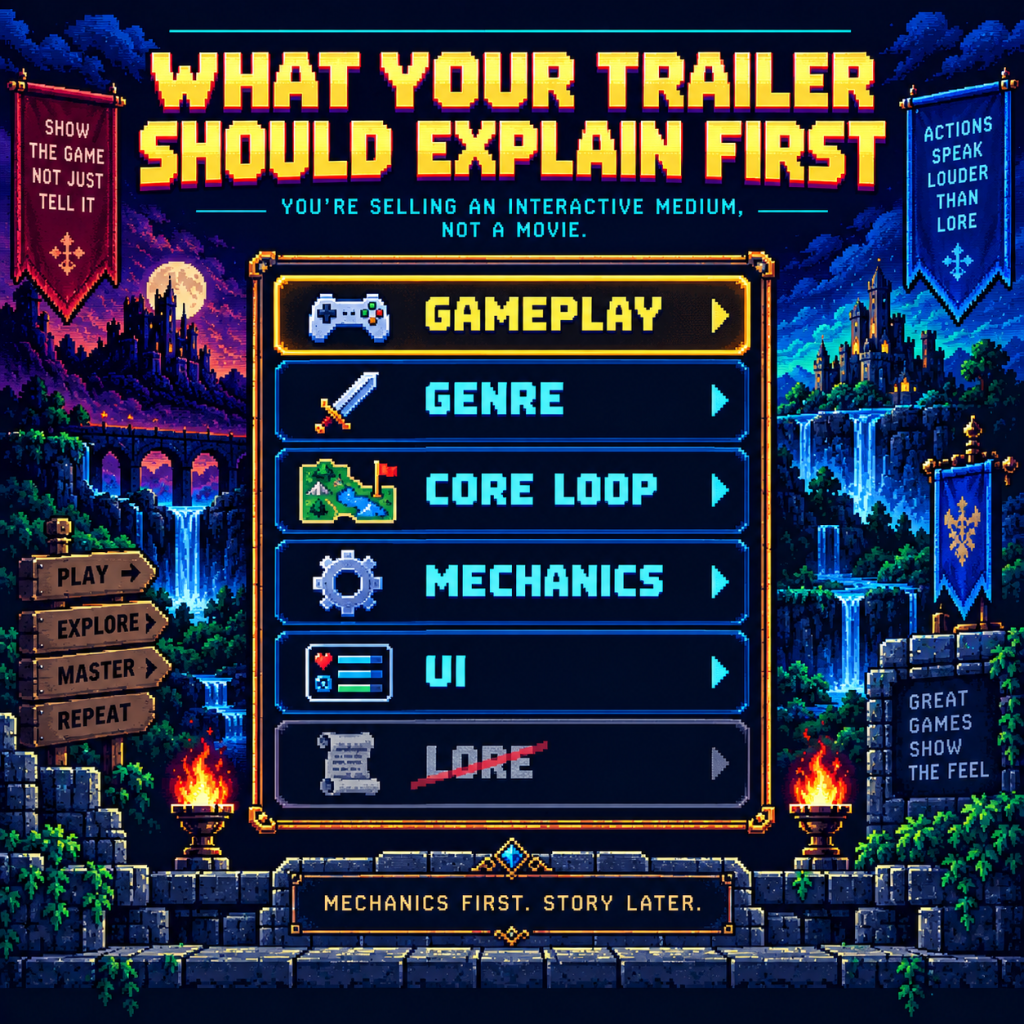
You need to show your audience what your game is about: what kind of gameplay it has, what genre or category it fits into. If possible, include a bit of the menu interface and how the mechanics work. Within that first minute, what you really need to make clear is what kind of game the player is about to get into.
They don’t care if the princess has been captured for years. They don’t care if the warrior was chosen for some destiny. What they care about is knowing why your game is going to be fun, and once they see it has enough to grab their attention and make them want to play it, the story can move to second or third place.
Now, here’s the key part: if your game is an RPG, a simulation, a point and click, or any other genre where the story takes the lead role, then obviously you will need to talk about the context and the lore of the game. A very common mistake, one that even shows up in game descriptions, is talking too much about context when, honestly, the person looking at it doesn’t care what happens in the story.
Zukowski backs this up with a simple writing rule: nouns are lore, verbs are gameplay (60 Game Marketing Mistakes). And on the professional trailer editing side, Derek Lieu, an editor with over 10 years of experience who’s made trailers for games like Half-Life: Alyx, Among Us, and Psychonauts 2, cites Tom Francis’s GDC talk, “How to Explain Your Game to an Asshole”: someone watching a trailer wants to know the mechanics first, the story is secondary because you’re selling an interactive medium, not a movie (source: derek-lieu.com).
Show Variety, Not Just Your Best Moment
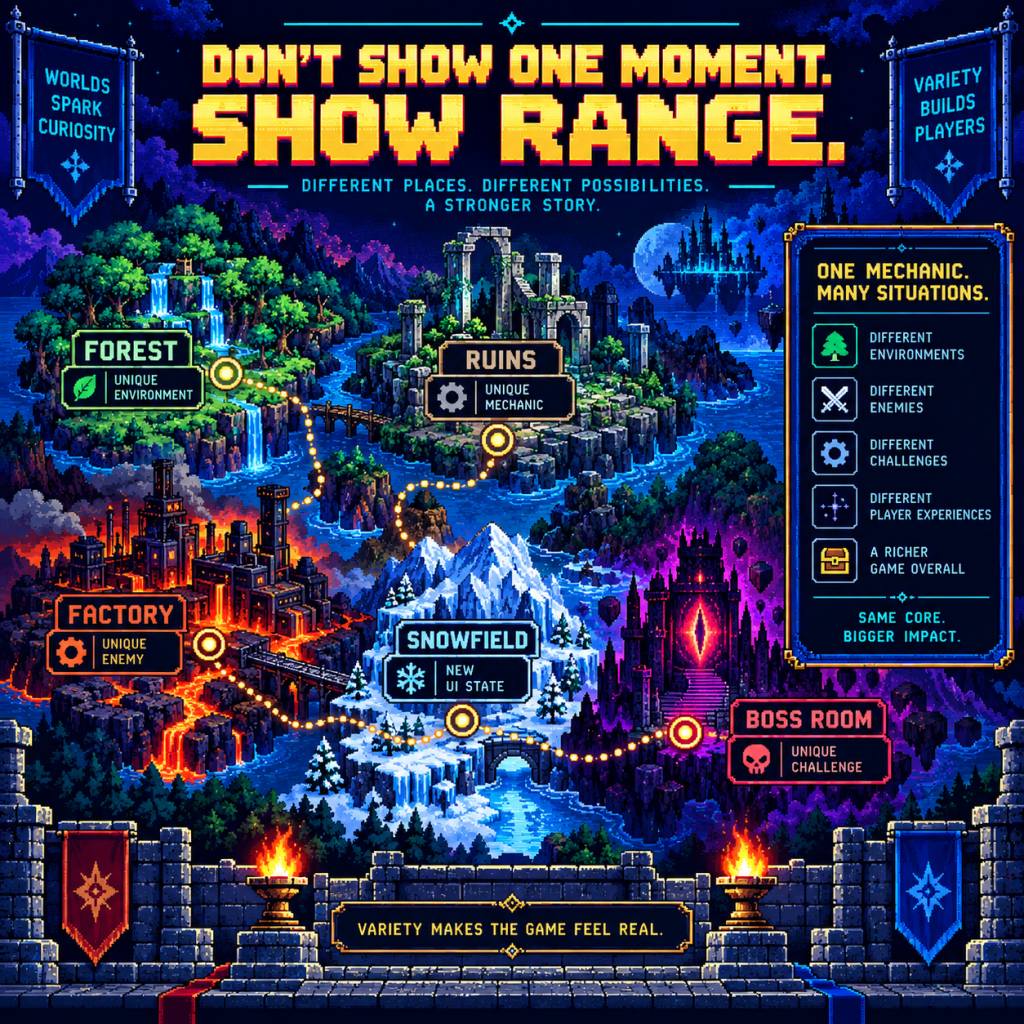
Highlight a mechanic in your game through different types of enemies. If your game revolves around a combat mechanic where you have to pull off certain combos, show that mechanic against different enemy types: the variety of hits, the range of moves your character can pull off, how the character interacts with each one of them. Also show some of the level variety your game has, and if your game has an interesting art style, it’s worth including that too.
Zukowski has a name for the opposite of this: a game that looks like an “asset swap” because every screenshot shows one biome, one enemy type, the same UI state. His recommendation lines up with yours: unique biome, unique enemies, unique gear per screenshot (60 Game Marketing Mistakes).
Music Isn’t a Detail, It’s the Emotion
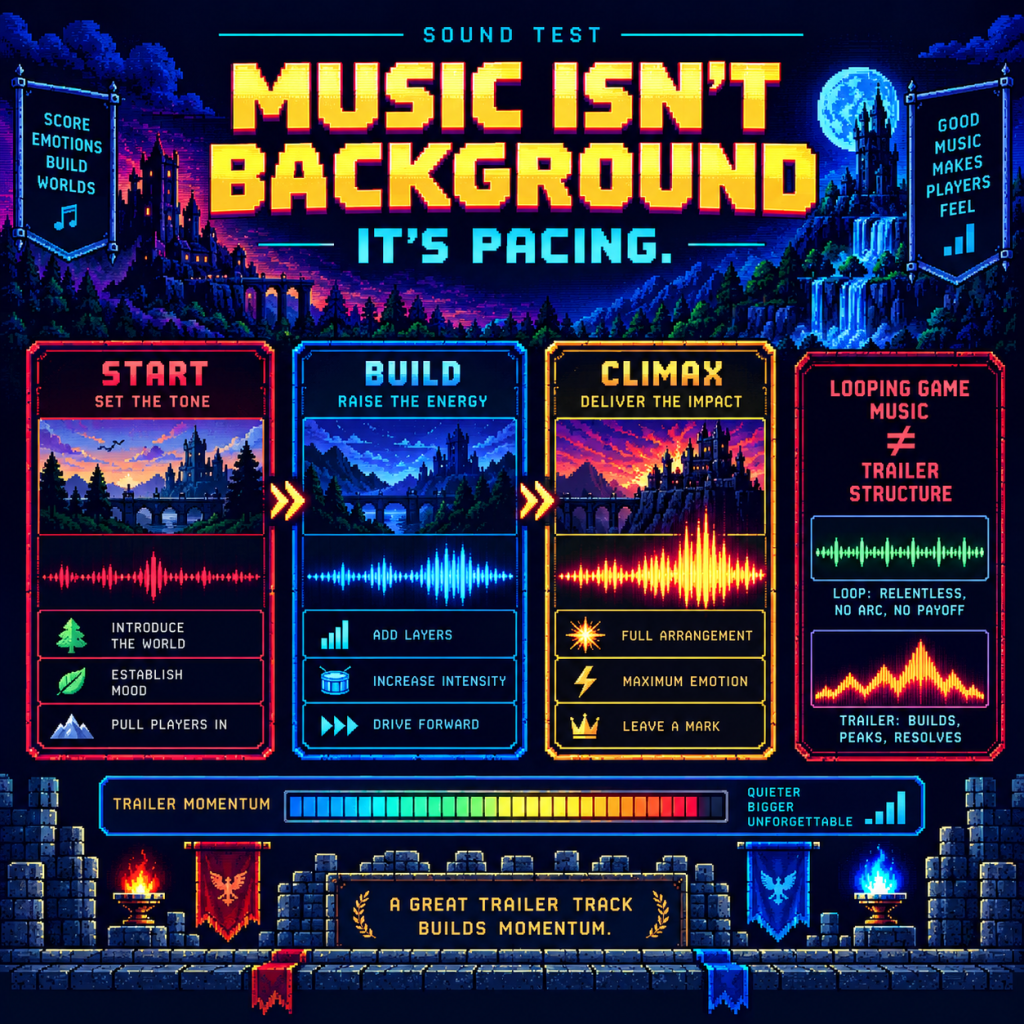
Highlighting a mechanic through different enemy types is one thing, but music matters too, especially for setting the emotion. It doesn’t have to be the exact final music of the game, but it should go hand in hand with what’s happening on screen and it should replicate that emotion.
Derek Lieu, a professional trailer editor, takes this a step further and explains why so many indie trailers fail here: trailer music needs a real arc, with a beginning, a build, and an end, working toward a climax. The problem is that most game music is designed to loop endlessly, so by its very nature it doesn’t come with that structure built in. The energy at the end of the trailer ends up sounding exactly like the beginning (source: 10 Common Indie Game Trailer Mistakes, derek-lieu.com).
You can touch on the story, just don’t drop it in the middle of the trailer. The story can be interesting, it can ride alongside the gameplay, but don’t take your finger off the gameplay line.
Don’t Assume, Ask
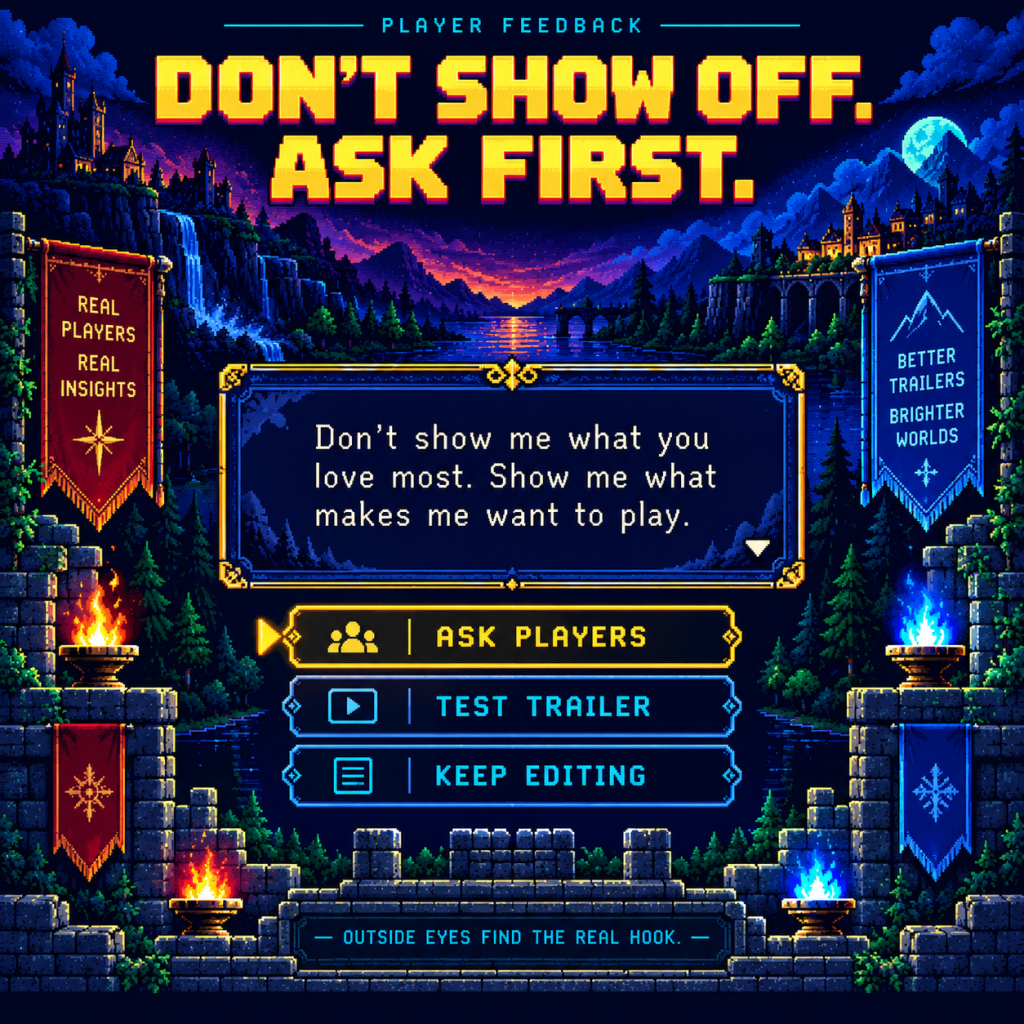
I know a minute sounds like a lot, or maybe like too little, to say everything about your game. But trust me, it’s possible. To pull it off you’re going to need to ask enough people, friends or family, what they’d like to see or what caught their attention most about other games. Don’t try to show off something that only catches your attention. Ask around and see what would actually stand out against the competition. Remember you only have a few seconds before someone scrolls to the next game.
Once you know what kind of gameplay everyone else is showing off, you can focus on showing the one thing that makes your trailer really pop.
How We Worked This into the Checkpoint ’38 Trailer
With our own Checkpoint ’38 trailer, we did exactly this, even though the game’s story carries real weight in the full experience. The nod to Papers, Please is direct: the player sits behind a checkpoint desk reviewing documents, with a stamp and an old phone on the counter, and that mechanic is already on screen within the first 11 seconds, with zero context text before it.
What we did differently was escalate the mechanic instead of repeating it. First you see a basic identity check. Then a “Work Permit” shows up with different requirements. Later, an “Aryan Ancestry Certificate” comes in as part of a full examination result. It’s not the same screen shown three times: it’s the same mechanic getting more complex, so the trailer shows system depth without spending a single second explaining lore.
For the story side, we solved something that sounds contradictory: how to show the game’s moral weight is real without dropping in a text card or a voiceover explaining the dilemma. The answer was one line of dialogue, delivered in an actual gameplay scene: two soldiers escort a woman with a Star of David sewn onto her coat, and one of the characters says, “I see, Herr Wachmeister. Fortunate, isn’t it, to be born with the right blood.” That line, said in the middle of the checkpoint scene and not in a separate cutscene, makes it completely clear what the game is about morally without pulling you out of the gameplay for a second.
That trailer got more than 100,000 views on Instagram.
The 5-Point Trailer Checklist
- Think about your differentiator gameplay. What kind of gameplay does your game have?
- Think about the category. What genre does your game belong to?
- Show variety. The same mechanic, across different levels and enemy types.
- Music matters too, especially for setting the emotion. It doesn’t have to be the final game’s actual music, but it should go hand in hand with what’s on screen and replicate that emotion.
- Get a good editor if you can. Someone who can pull all of this together and actually understands pacing. If not, at least use a solid editing tool that lets you make every change you need.
We know it’s your baby and you want to show off the whole game, but for a video you always have to go with the most standout material. And don’t forget to watch other trailers from games similar to yours, to see what they choose to focus on.
Sources cited: Chris Zukowski, howtomarketagame.com — 60 Game Marketing Mistakes And How To Avoid Them (PDF). Derek Lieu, professional trailer editor — Gameplay Preview vs Trailer and 10 Common Indie Game Trailer Mistakes.

 Game Marketing XP