Publishing a game means a lot more than picking a console, slapping a rating on it, or figuring out what Steam charges you. It also means knowing, depending on the type of game you’re selling, what the limitations are in each country. That’s exactly what we learned the hard way with Checkpoint ’38.
The game deals heavily with a sensitive topic: Nazism. I say that from the privilege of being from a Latin American country — we didn’t live that conflict up close, so it’s not a topic we weigh every day. In the Americas it can feel distant, almost like something out of a history book; but in the European countries that lived through World War II firsthand, it’s still an open wound. And that’s exactly where the difference in perception matters most — what feels to you like “just a game theme” can carry a lot more weight in another market. That privilege ran out fast once we started moving toward launch.
The signal showed up earlier than we expected: just from posting the trailer on social media, we already had a clear idea of the kind of reaction we were going to get. After more than 200,000 views, it was obvious people who didn’t fully agree were going to show up — and that’s normal. A game with a strong theme brings strong reactions.
What we didn’t expect was that the real bottleneck wouldn’t come from users, but from the platform itself. Our Steam page got bounced more than 3 times for dealing with Nazism in a game also distributed in Germany — one of the countries that watches this specific topic most closely. And they sent it back because, honestly, we didn’t know the context or the requirements before we tried.
If you’re publishing something like Mario, Sonic, or a hockey game with no sensitive themes at all, you probably won’t run into any of this. But the moment your game touches something heavier, it’s worth stopping to look at what happens to any studio, not just ours. Researching this ahead of time isn’t the most fun way to spend an afternoon, but getting your page bounced three times is a lot more of a pain.
The countries you actually need to check
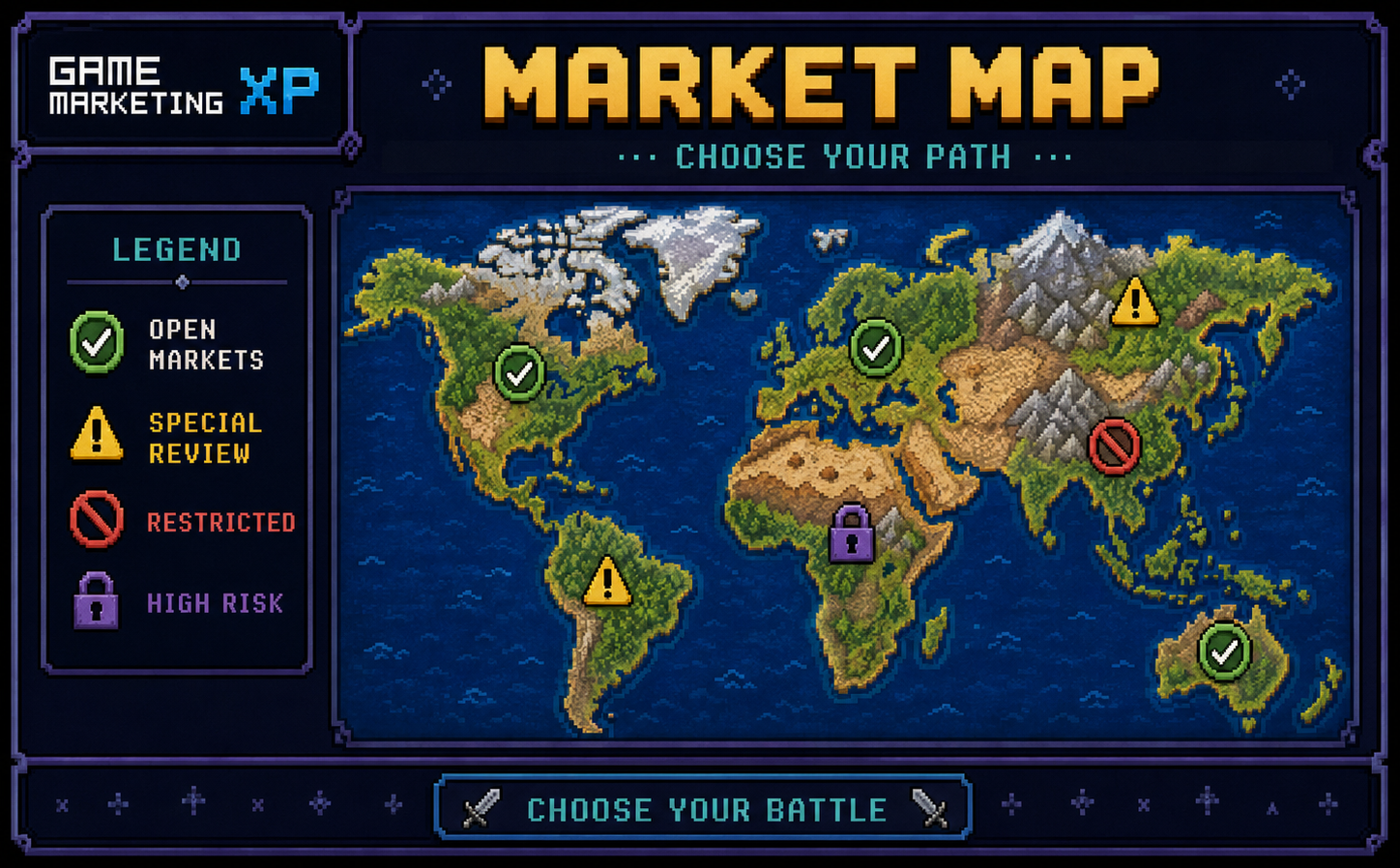
You don’t need to be living under a rock to know that violence, drugs, same-sex relationships, gambling, or religious and political symbols generate noise. What’s less obvious is how each country regulates it — and that’s where most indie studios trip up: they only look into this once the storefront is ready, the trailer is shot, and the rejection notice shows up.
Facing a restriction, there are almost always three paths: modify the content for that region, restrict distribution there, or seek a special approval. Which one makes sense depends on how much that market matters for your game versus the cost of maintaining an alternate version. Here’s how the rules look in six key markets:
🇩🇪 Germany
- What’s restricted: symbols of unconstitutional organizations — swastikas, SS insignia, images of Hitler.
- The exception: there’s a legal clause (Sozialadäquanzklausel) for artistic, scientific, or historical documentation purposes — never glorification. It only extended to video games in August 2018; before that it only applied to film and literature.
- Who authorizes it: the USK (Unterhaltungssoftware Selbstkontrolle) reviews each case individually — it’s the organization we had to make our case to directly. Official site: usk.de.
- Examples: Wolfenstein spent years with swastikas swapped out and plotlines altered in Germany; Youngblood (2019) was the first title in the series to release uncensored under the new rule; Through the Darkest of Times got approved for its critical, non-celebratory take on Nazism.
- Typical resolution path: a clean build, regional restriction, or case-by-case approval from the USK.
🇨🇳 China
- What’s restricted: blood, corpses, or pools of blood (not even recolored), gambling games, and anything the authority considers a “historical distortion” of China.
- Who authorizes it: a state approval committee under the State Press and Publication Administration.
- How it typically works: many Western games ship a China-specific version, sometimes distributed separately from global Steam through “Steam China.”
- Typical resolution path: an edited regional version, almost always coordinated with a local publisher or distributor — approval runs through the committee, not just the platform.
🇦🇺 Australia
- What’s restricted: it’s not selective censorship — if a game doesn’t fit any classification category, it gets Refused Classification and its sale is banned outright.
- The most common trigger for indies: illegal drugs used as a reward or incentive mechanic.
- Examples: Saints Row IV was rejected over a consumable alien drug used as an in-game reward; Fallout 3 renamed its morphine to “Med-X” worldwide to sidestep the issue; Disco Elysium: The Final Cut was initially rejected and later reclassified R18+ once regulators determined the game actually punishes those choices rather than rewarding them — narrative context matters.
- Typical resolution path: adjust the mechanic or the narrative before launch.
🕌 Middle East (Saudi Arabia / UAE / Gulf)
- What’s restricted: same-sex relationships, nudity or explicit sexual content, religiously offensive content, gambling, drugs, and negative portrayals of the region.
- Who authorizes it: the National Media Council (UAE) and equivalent bodies across the region.
- Examples: The Last of Us Part II and Mass Effect 2/3 were restricted over same-sex relationships; Spec Ops: The Line was partly banned for depicting a fictional, collapsed Dubai; GTA V was banned for years over violence, sex, and drugs, with the ban only lifted in 2025.
- Typical resolution path: a regional version without those scenes or themes.
🇷🇺 Russia
- What’s restricted: since December 2022, any “positive portrayal” of LGBT people in any medium, including video games — the law expanded what previously only applied to content aimed at minors.
- Consequences: fines up to 400,000 rubles for individuals and 5 million for organizations.
- How it plays out in practice: there have been reported cases of Steam pulling or restricting games with LGBTQ content specifically for Russian accounts, apparently in response to pressure from the state regulator (Roskomnadzor).
- Extra context: it’s a market with broader geopolitical risk beyond any single game’s content — there have been legislative moves to block entire platforms.
- Typical resolution path: regional restriction, sometimes enforced by the platform itself.
🇯🇵 Japan
- What’s restricted: nudity and sexual content, judged more strictly than graphic violence — the opposite of what you’d usually expect from Western-style ratings like the ESRB.
- Who authorizes it: CERO, which rates games from A (all ages) to Z (18+) across nine categories: romance, sexual content, violence, horror, alcohol/tobacco, gambling, crime, drugs, and language.
- Example: The Last of Us Part II got the maximum Z rating in Japan, but a sexual scene still got censored, while the violence and dismemberment — despite being intense — went through with relatively less alteration.
- Typical resolution path: targeted visual censorship — mosaic or trimming of specific scenes.
Is it worth fighting for every market? Based on Steam bandwidth consumption by country (GameDiscoverCo, April 2024), China dominates at 25.6%. Of the rest, only Russia (5.9%) and Germany (4.4%) individually weigh in above 4% — the Middle East, Japan, and Australia each sit somewhere between 1.6% and 2.7%. For an indie studio, resolving Australia or even the entire Middle East region probably costs less in lost sales than the engineering or legal time it takes to fix it. Letting go of Germany or Russia is a heavier call.
With that full picture in mind, let’s go back to Checkpoint ’38 — because that’s exactly how we handled our specific issue with Germany.
How we handled it with Checkpoint ’38
Fortunately, with Checkpoint ’38 the only issue we ran into was Germany — the game isn’t that explicit, and most of the story unfolds from the point of view of a Nazi character who has a change of heart. There’s no blood, no explicit violence, no sexual content. Even so, staying firm on certain graphic choices can still generate friction under German rules.
The key was being clear on what we were actually presenting and what we weren’t: we’re not glorifying Nazism, we’re showing the arc of a character who switches sides. That was exactly the case we made to the USK (usk.de) — the same body that reviews, case by case, whether a game crosses the line between telling a story with historical purpose and glorifying it.
And this is where it stops being just a legal compliance issue and becomes a marketing and community management issue, because how you handle the controversy matters just as much as the content itself:
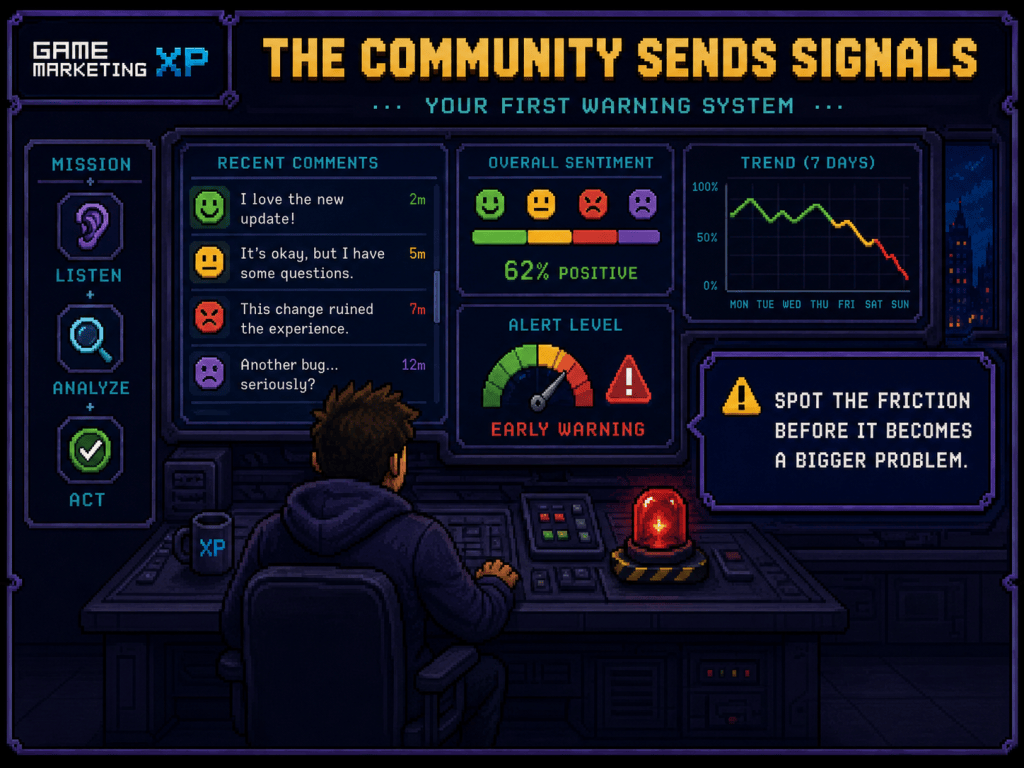
- You catch the controversy before the review does. The sentiment on social media after the trailer is basically your first free market study. If your community manager already sees friction there, that’s the signal a ratings board is going to see it too — better to have that mapped out early than reacting after the fact.
- Never turn your official channel into an argument. Zero direct back-and-forth with upset users, zero fights in the comments. As a brand, your job is to hold a consistent public stance — not win a one-off argument you’ll have to explain to your team later.
- Let the narrative carry the message, not your personal opinion. Instead of the studio “declaring” a stance, you let the player make the decisions inside the game. It’s a design choice, but it’s also pure marketing: it lowers the risk of getting labeled “the game that glorifies X” and keeps the door open to more people who’d otherwise never have gotten close.
- Monitoring your channels is part of your compliance, not just your reputation. Keeping a close eye on your social channels isn’t just about “seeing what people say about you” — it’s the earliest signal you’ll get for how a ratings board or a platform is going to react. That data feeds straight back into your launch strategy.
The pre-launch checklist (by country and by region)
- Do your sensitive-content inventory, no excuses. Sit down and write down everything that applies: graphic violence, blood, drugs or alcohol, gambling, sexual or romantic content, same-sex relationships, religious or political symbols, and how you portray real countries or regions. If your game has any of this, you already know where the problem could come from.
- Cross that list against the markets that actually matter to you. You don’t need to solve for all six countries in this guide if your game doesn’t sell meaningfully there — prioritize based on your real target audience, not the full list.
- Decide your stance per problematic market before you’re forced to decide under pressure. Do you modify the content, restrict the region, or go for a special approval? Each path has a different cost — development time against revenue left on the table — and that call is better made calmly than at the last minute.
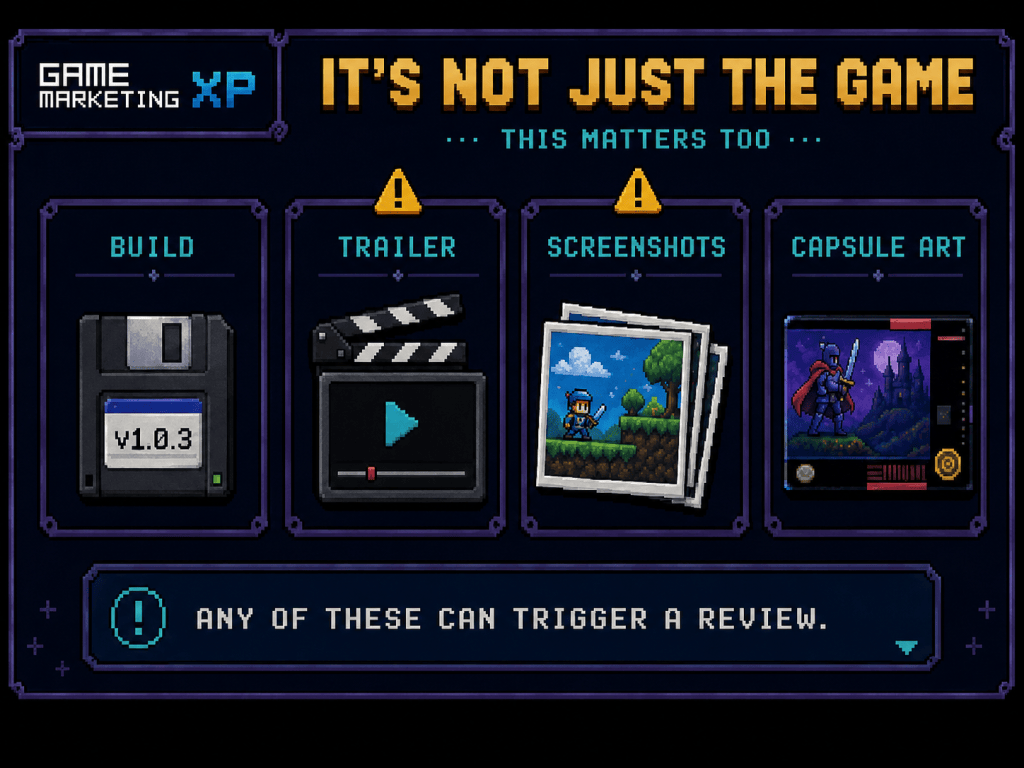
- Don’t just review the game — review your trailer, screenshots, and capsule art just as hard. That’s often exactly what triggers the review, not the build.
- Have your purpose justification ready before anyone asks for it. If your game touches a sensitive theme with serious intent — historical, artistic, critical — have that evidence put together ahead of time. It saves you time when a platform or ratings board review comes up.
- Don’t assume skipping a market is free. Germany, Japan, or the Middle East represent a real chunk of PC players — weigh the trade-off with actual data, not just to avoid the paperwork.
If your game touches something sensitive and you don’t want to find out about the Steam rejection the hard way, check this before you build the page, not after. At game marketing xp we’ve run into this exact kind of case — if you’re putting together your game’s launch and don’t know where to start with this, reach out. You’re already on the site, so just send us a message.